I Walked Almost 4 Miles on the Beach. Here’s What It Did for My Body
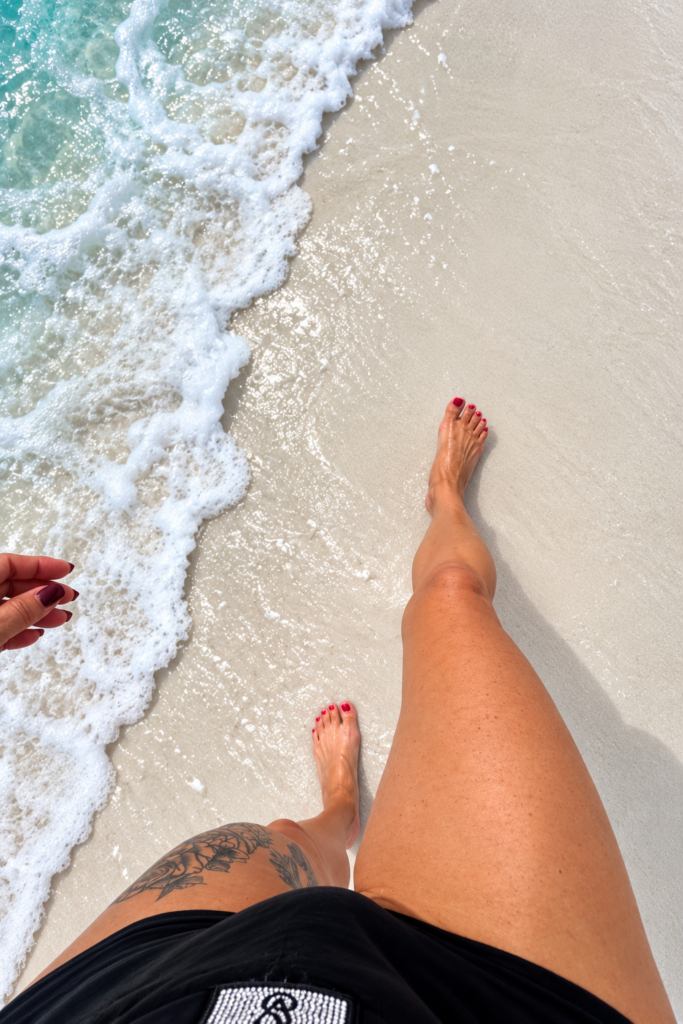
I recently spent a few days in Fort Walton Beach, Florida, and one morning I decided to head out for a walk along the beach.
Well, that little walk turned into almost four miles!
According to my Apple Watch, I walked 3.92 miles in just under two hours.
I wasn’t trying to get in some big workout. I was on vacation, the beach was beautiful, and I just wanted to walk.
But afterward, I got to wondering how much of a workout I’d actually gotten. I know walking on sand is harder than walking on a sidewalk, but what exactly is it doing for my body?
And more importantly, is all that walking helping me build the legs and glutes I’ve been working on?
So I decided to do a little research.
First, Walking on Sand Is a Workout of Its Own
f you’ve ever walked very far on the beach, you already know it’s different from walking on pavement.
Your feet sink into the sand, the ground moves underneath you, and you have to work a little harder to push yourself forward.
And if you’re walking through the really soft, dry sand, you can definitely feel the difference!
Depending on how soft the sand is, walking on it can require considerably more energy than walking the same distance on a firm surface.
But what interested me most was finding out which muscles are actually doing all that extra work.
My Glutes Are Getting Some Extra Work
Now we’re talking!
If you’ve followed along with my fitness journey, you know I’ve been putting a lot of effort into rebuilding my strength, especially in my legs and glutes.
Hip thrusts and Romanian deadlifts have been regular parts of my workouts, and I’m always interested in finding other ways to keep those muscles working.
Your glutes are involved in walking no matter what surface you’re on. They help move you forward and keep your hips and pelvis stable.
When you’re walking on sand, especially when it’s uneven or your feet are sinking, your body has to make additional adjustments to maintain your balance.
That gives the muscles around your hips and glutes another kind of challenge.
Now, am I going to replace my hip thrust machine with a bunch of beach walks?
Absolutely not!
Walking can help with muscular endurance, but it’s not going to replace the resistance training I’m doing to actually build muscle.
Still, I love knowing that something I enjoy doing is also giving those muscles a little extra work.
What About My Legs?
Your glutes aren’t the only muscles working harder.
Your quads, hamstrings, calves and all those smaller muscles around your ankles and feet are involved, too.
Your thighs and hamstrings
Your quadriceps, which are the muscles on the front of your thighs, help support your knees and control your movements as you walk.
Your hamstrings, on the backs of your thighs, help move and control your legs with every step.
Walking on soft sand can make the whole process a little more demanding because you don’t have a solid surface to push against.
Your calves and ankles
This is where I think a lot of people really notice the difference.
When you’re walking on sand, your ankles and feet are constantly making little adjustments to keep you balanced.
Your calves are also working to help you push forward.
If you’ve ever finished a long beach walk and wondered why your calves or feet were so tired, all that extra work may explain it.
And apparently, you can overdo it if you’re not used to walking on sand.
So if beach walking is new to you, starting with a shorter distance is probably a better idea than heading out for four miles on your first day!
I Was Working My Core and Back, Too
This was something I hadn’t really thought about.
I’ve been trying to put more emphasis on my core, posture and flexibility because I want to feel stronger overall, not just build muscle in my legs and arms.
And I’ve definitely learned that when my back starts getting tight, I need to pay attention to what my body is telling me.
It turns out your core has a job to do even when you’re just walking.
Your abdominal and back muscles work together to help keep your body upright and stable.
When the surface underneath you is uneven, your body has to make small adjustments to maintain its balance.
That means the muscles supporting your spine, along with your core and hips, are all helping you stay steady.
Now, I’m not claiming that walking on the beach is going to give me six-pack abs or fix every backache.
But I do like knowing I’m getting some additional stability work while I’m out enjoying myself.
And Let’s Not Forget About the Cardio
Almost two hours of walking is a pretty good amount of movement for one morning.
My Apple Watch recorded just over 200 active calories for that walk, although those numbers are estimates.
But I’m more interested in what that activity is doing for my overall health than I am in how many calories I burned.
At 52, building muscle is important to me, but so is taking care of my heart, maintaining my endurance and staying active.
Walking gives me another way to work on those things without doing the high-impact workouts that my knees and feet don’t particularly appreciate.
And walking on the beach certainly beats staring at a treadmill for two hours!
For me, the goal is to make regular walking part of my routine alongside strength training.
So, Can Walking on Sand Actually Build Muscle?
This was one of my biggest questions because I’m specifically working on building and maintaining muscle.
And the answer is a little bit of yes and no.
If you’re not used to walking on sand, it can definitely challenge muscles you may not normally use as much. Over time, that kind of activity can help improve muscular endurance and stability.
But if your goal is to build noticeably stronger or fuller glutes, you’ll still want to include resistance training.
That’s why I’m keeping my hip thrusts, squats and Romanian deadlifts.
Walking is an addition to my workouts, not a replacement for them.
And that’s perfectly fine with me.
I actually like having different ways to stay active instead of feeling like every bit of exercise has to happen in the gym.
A Few Things I’d Keep in Mind Before Walking on the Beach
After learning more about beach walking, there are a few things I’d pay attention to before making a habit of walking long distances on sand.
- Start with the firmer sand. Walking near the water is usually easier than walking through deep, dry sand. Just watch out for steeply sloped sections of beach.
- Build up your distance. Your calves, ankles and feet may be doing more work than they’re accustomed to.
- Take some water. Especially if you’re walking in the Florida sunshine!
- Don’t forget your sunscreen. Even if you’re heading out early, you’ll want to protect your skin.
- Pay attention to how you feel afterward. A little muscle fatigue is one thing, but pain is another.
And if you’re walking barefoot, keep an eye out for shells, sharp objects and anything else you might not want to step on.
Getting Stronger While Doing Things I Enjoy
One of the things I’ve been figuring out during this whole fitness journey is how to make being active part of my everyday life.
I enjoy strength training. I like challenging myself, increasing my weights and seeing what my body can do.
But I also want to walk on the beach, take trips, spend time outdoors and do things simply because I enjoy them.
And if some of those activities happen to be good for my health, that’s even better.
By the time I finished my beach walk, it was around 11 o’clock. The sun was shining, the water looked beautiful, and it was my last full day of vacation.
So I went back, packed my cooler with some ice, grabbed my sunscreen, towels and float, and tried to decide which bathing suit to wear.
Red, black or ombré?
I ended up with a pretty good workout that morning, and I still had the rest of the day to enjoy the beach.
Not a bad way to spend a vacation!
XO ~Amy Marie 🖤